SEP Exchange Series (Scandinavia & Eastern Europe)
- Daryl Hong
- Jun 11, 2021
- 40 min read


Moving on towards Scandinavia and Eastern Europe, these are schools that are situated into the Scandinavian region as well as in Russia, which I classified as part of Eastern Europe. I hope this guide/sharing can help you make a better and more well-informed decision on which school you might want to include in your future SEP choices (after COVID for sure)! I really want to give a big thanks to my friends who have spent their time to write about their school (Some of them really put in a lot of effort), so don’t forget to thank them as well in the comments okay. I will pass on the thanks 😛 I only did the collation and some edits here and there. Some of us are also willing to share more information so just let us know if you have more questions!
Schools Covered:
Denmark: Aarhus School of Business (written by myself, Huang Teng Yue and Sarah Chia) Copenhagen Business School (Written by Clemon Ho, Ryan Teo, Qian Hui)
Sweden: Lund University (Written by Glennis, Xu Ling, Jasmine Koh) Uppsala University (Written by Claudia Sng) Stockholm University (Written by Stacey Lee)
Norway: Norwegian School of Economics (Bergen) (Written by Dawne Chua)
Finland: Aalto University (Written by Megan Quan)
Russia: University of St Petersburg (Written by Jamie Lee)
Denmark
Aarhus School of Business
By Daryl Hong, Huang Teng Yue, Sarah Chia (Sem 1)


My Aarhus friends from NTU/NUS and SMU! (Creds to yours truly 🙂)
Perfect for: Students who want to travel a lot due to their chill school attendance culture but can bear long travel hours to get to the nearest airports.
Ease of getting in: Around 8 slots, got in at around 78 points (Biz students)
School culture: D: Chill culture, orientation programme was fun. However, as I was travelling a lot, I was not able to join much school events. There is a bar inside the school, where the local students have mentioned that it was amazing, with cheap alcohol. One thing I regret not doing was to spend more time with the friends I made during orientation week. Shoutout to my amazing buddy, Emma, for making me feel at home! During the orientation week, we had events like stand-up comedy night, free-flow drinks at a local bar, exploring the city through an Amazing Race (The city itself is small enough to explore on foot). That was definitely very fun! S: Danes are super friendly!! There is quite a party life in Aarhus, with a bar in the school compound HAHA. i think it can be both fun + study focused. like they have study groups/sessions for some modules as well!
Attendance levels: D: Aarhus really has a self-driven student culture, and they do not take attendance in classes. You need to be focused and be self-aware of the deadlines. Everything is uploaded online on their website. I only went school for around a month. However, it depends on your modules as well. Finance modules might require more time and effort compared to marketing for example.
Exam Policies: TY: My assessments were 100% finals and all of them were conducted electronically at the exam venue so make sure you treasure your laptops properly and don’t lose it if not it’ll be lots if trouble. Some are open book and some are not but I don’t think the difficulty varies alot with this aspect, as long as you familiarize well with the syllabus you’d be able to pass (with flying colours for some) cus the profs are generally pretty lenient with marking. D: Exams are either take home assignments (Done within 72 hours), or taken in school (Open Book/Closed Book).
Modules offered: D: I was able to clear a total of 24 MCs, BSP3701 (Strat Management), MKT3415 Marketing in a Digital Age, and another 12 MCs worth of MKT modules. I also did a module about Denmark which was able to be mapped back to a MNO random module. However, this school does not offer the 4 free MCs if you complete 5 modules there, unlike Copenhagen. (Ps: I’ve heard from my juniors that Aarhus has changed some of its module offerings so do constantly check the school website for the latest updates on modules!)
TY: Mapped back 24MCs (6 mods) which is 30ECTs for European schools, the maximum number of credits you can bring back. My modules were 3 Fin3k modules under Topics in Finance (which helped clear my fin spec electives), Fin3701, Fin3703 (Fin core) and Bsp3701. I’ve learned that in their education system, professors are required to be active researchers in order to be able to teach, so that means they actually know their stuff. Most times they make learning in class a lot more interesting as they frequently give their own inputs, perspectives and new findings into teaching that are outside of what the boring textbooks will teach.
S: I was able to map most of my Finance modules!
Location: Aarhus is the 2nd largest city in Denmark, and it is known to be a student city given the number of students staying in the city itself. However, it is located very far from the main airport, Copenhagen, around 3-4 hours by Bus or Train which will cost around S$15-30 one way dependent on how early you buy the tickets. There is Aarhus/Billund airport nearby but they have lesser flights and connections to other European hubs. The costs for the shuttle buses to the airport also cost upwards of S$20 so do factor this in when you are planning to travel often. Often, I will combine different cities together and travel at one go to save these small costs!
Getting around: D: It is a bike city, so many of us rented bikes from Swapfites, but we ended up taking the buses because it was either too cold, or it was more convenient to take the bus. TY: As Singaporeans there you’ll start to find options to save money, for example knowing which bus lines doesn’t require ticket checking, so you don’t have to buy tickets for those trips. Buses are differentiated based on their colours. For example, for blue buses, the bus conductor will check for your ticket before boarding, while yellow buses do random spot checks on whether you did buy a ticket. Do your necessary planning of risk and note the expensive fines you will incur if you do decide to not buy the tickets!.
Cost of Living: Overall, Denmark is expensive to eat out, and every time I am in Aarhus, we usually buy groceries and cook at home. Meals outside will cost a minimum of $S15, going up to S$50 dependent on the cuisine. TY: Do not eat out unless absolutely necessary! (unless during busy periods like exams when there’s no time to cook). Service is extremely expensive there in Denmark, so as students, we generally buy groceries and cook ourselves everyday. There’s a huge supermarket 20min walk away from my apartment so it’s pretty convenient! (bring your own grocery bags, it’s easier, cheaper and more environmentally friendly). You will need to pay for the bags, unlike in Singapore. Basic groceries are around the same price as Singapore like meat, vegetables, condiments etc. But fruits are provided according to seasons (Eg: There were no more peaches nearer to winter and imported fruits are really really expensive so just stick to their local products)
Accommodation choices: D: If you choose the school accommodation, it is much cheaper (I paid only around S$500 per month) for a two-storey two bedroom house with own kitchen and toilet! It is randomly allocated and my house is located around 15 minutes away from the school by bus (30 mins by bike). TY: For AU, the school has both school dorms and properties around the outskirts of Aarhus that they rent out to students. So my apartment is right in the middle of an estate, and my neighbours are all Danish families instead of fellow students so it’s pretty cool and peaceful:) (the stars that can be seen every night from my balcony made exchange an even better experience) My accommodation is the same as Daryl, it’s a 15min bus ride to the city and 15min bus ride from my apartment so it’s very central, But one thing to note is that the intervals between bus arrivals are HUGE so you’ll have to check the bus timings carefully and make sure to not miss your bus if not you’ll be late for class.
Closing Thoughts: D: I had no regrets choosing Aarhus. Not only were the school curriculum chill (no attendance policy), i made the best friends and had a great time cooking and sharing food with them on the nights I was in Denmark. The Danish, even though they look unapproachable, were actually super friendly people! If I did not travel as much as I did, I would definitely have integrated myself more in the school culture and partied with them harder! If you are someone who wants to have fun while staying in a safe and lovely neighbourhood, I would definitely recommend this city!
Copenhagen Business School
By Ryan Teo, Clemon Ho, Qian Hui (Sem 1)


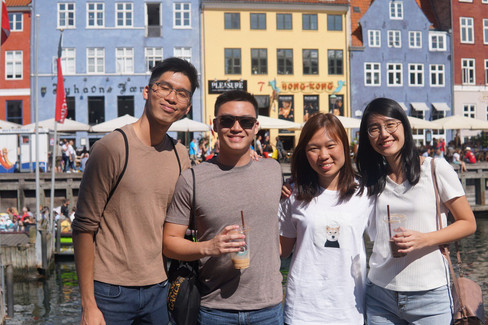
NUS/SMU/NTU students at CBS! (Creds to QH)
Perfect for: R: Students who don’t want to go to school, or have an obscene interest in the Danish Culture.
C: Also for those who want to travel, do not mind skipping classes and doing assignments on the road while traveling.
QH: Students who enjoys independent learning, studying in international environment (CBS has more than 5,000 international students each academic year) and learning in interactive, flipped classroom environments.
Ease of getting in: 86 points, 8 people. Not easy.
School Culture: R: Danish people drink and party a lot, and while friendly, they are not exactly inclusive. I was lucky to have a very friendly and welcoming buddy. Don’t expect to assimilate into the Danish culture or make tons of Danish friends, you most likely won’t.
C: Anyway, you would/should be traveling around.
QH: Denmark is the 2nd happiest country in the world by 2017 World Happiness Report so it is generally nice and easy to ease into the school with many friendly staffs and students. A balanced work/leisure time is very important to Danes, evident from how they ’hygge’, balance welfare, environment, trust and freedom all factors that make them happy in school. Locals are generally quite friendly and helpful. There is rarely any communication barrier as the general population speaks English. CBS has many student clubs, excursion activities and sports activities from beginner’s to advanced level so you get the opportunity to learn new skills and socialise with international students. There is also a paid orientation where you get to learn about the rich Danish culture through movies and leisure activities.
Attendance levels: QH: No attendance taking, you are only accessed at the exam. Grade is neither affected by attendance nor how active you are during class (So for students who want to skip school to travel, CBS is perfect!).
Exam Policies: R: Depends on module, mostly take home assignments. I had one physical exam that was done in the computer lab.
QH: Written exams
Projects: where you work with a theoretical problem statement or a case based on practice – either individually or in groups
Shorter written exams: where you are given an assignment you have to answer within a limited time period e.g. 24, 48 or 72 hour exam assignments.
Sit-in exams: where you meet up at CBS and do a written exam typically in 4 hours – with or without exam aids.
Oral exams
A presentation of a given topic
A syllabus exam where you will draw a question or topic
Oral defence of a written paper
Modules offered: R/C: FIN 3701, two FIN Electives, BSP 3701 Strategic Management.
QH: Took 5 courses worth 37.5 ECTs at CBS which is an equivalent to 24MCs in NUS (7.5 ECTs in CBS = 4MCs in NUS)
An extra 5th NUS module (worth 4 MCs) will be credited for every Four (4) 7.5 ECTS courses taken at the above partner universities.
The 5th NUS module will be a “Business Module with the code BXT3041”. You may use this module BXT3041 (worth 4 MCs) to fulfill your Unrestricted Elective module requirement in your degree program.
Please note that the 5th module will only be credited if you have passed all the four (4) 7.5 ECTS courses at the partner university. If you take three (3) 7.5 ECTS courses and one(1) 5.0 ECTS course at the partner university, the 5th module will NOT be credited (ie, only 16 MCs will be transferred back to NUS). If you only passed 3 courses, then only 12 MCs will be transferred back to NUS.
CBS module: NUS equivalent
Choice 1BA-BDMAO2002U Corporate Finance: FIN3101 Corporate Finance
Choice 2BA-BHAAV2389U Behavioural Finance: FIN3120X Topic in Finance: Behavioural Finance
Choice 3BA-BISHO2002U Risk Management: FIN3714 Financial Risk Management
Choice 4BA-BHAAC2262U Entrepreneurial Finance: FIN3120X Topic in Finance: Entrepreneurial Finance
Choice 5BA-BHAAV1366U Strategic Management: BSP3701 Strategic Management
Exam grading system: Follows a 7-point grading scale (no bell curve). Scores range from -3 , 0, 2 (Grade E), 4 (Grade D), 7 (Grade C), 10 (Grade B), 12 (Grade A). Best thing? 02 is the minimum grade for passing an exam!
Location: R: Copenhagen is very small (smaller than Singapore by quite a bit) so getting from one place to another is really easy.
C: The school is like SMU in the sense that its campus is spread out. Each section of the school is near to an MRT station. There is direct train to the airport.
QH: The CBS campus is located in a very prime and central region known as the Frederiksberg. We have lectures and tutorials held at 4 different primary buildings being:
Solbjerg Plads: Main campus building with a wide range of auditoriums, class rooms, group study rooms, the academic bookstore as well as home to the largest of the CBS Libraries.
Kilen: A few steps from Solbjerg Plads you find Kilen with teaching facilities and home to the President’s office and top management at CBS.
Dalgas Have: Architectured building with class rooms, study rooms and library.
Porcelænshaven: Former porcelain factory now housing the administrative location of the International Office as well as teaching and research facilities.
The school is close to the centre of Copenhagen so it is easily accessible from your hostels. Moreover, Copenhagen Airport is only a short distance from the city center by metro or train (25mins). From there you can fly to and from destinations within Denmark and around the world.


Frederik Church, Tivoli Gardens and Nyhavn: Famous Canal Houses of Copenhagen
(Qian Hui’s photos in Copenhagen!)
Getting around: R: Public transport is expensive as hell. You should cycle where possible. Rent a bike from Swapfiets and try navigating around, it’s pretty fun and all the Danes do that anyway.
C: You can buy a monthly pass but you will be travelling quite often so you probably won’t need it.
QH: Travelling around Copenhagen is easy by public transportation as it is relatively small city. Public transportation is reliable, efficient and can take you everywhere. In a big city like Copenhagen there are good reliable options for transportation such as bus, metros and local trains. However, public transport is extremely expensive as there is no student fare. An average 10mins bus/train ride cost around SGD 3.50. Hence, investing in a second-hand bike for your stay here might be the most viable option. Most of us rented a bike during our stay there (rental is at SGD$20~ per month) as there is a strong cycling culture in Copenhagen. There are about 400km of cycle paths and more than 1/3 the capital’s population commute to work by bicycle. However, if you are not an experienced cyclist and do not feel confident on a bike, you should not make your first attempt in the fast-paced traffic of Copenhagen. Many Danes ride very fast and you are advised to practice first.
Cost of Living: R: If you want to save money this is the wrong place to have an exchange. Everything OBSCENELY expensive here. McChicken meal? Sorry that would be $13. Cafe meal? $20 and above. You could technically save by buying kebabs and cooking whenever possible, that was what I did.
Accommodation: R: You can stay near campus (school-designated accomodation) or rent your own housing; I would say expect to pay at least S$900 a month minimum if you want to be near school (average is about $1.1k even for a tiny apartment.
C: For us, we spent around S$800/person/month. It was a shitty apartment but cheap for Copenhagen standards. Would advocate staying in school for roughly 900/month at least you will have proper facilities and have a chance to meet new friends.
QH: The CBS Housing Department has access to seven student residence halls, and priority is given to international exchange students, who are in Copenhagen for a short period. I stayed in one of the CBS housing apartment, Svanevej 4 which was located slightly further away from the school campus (20mins train/bus). There are a good mix of international students at most of the hostels in CBS so I recommend staying in these hostels to meet international friends! More information about the services of the CBS Housing Department, the various housing options, and allocation process (deadlines, payment procedure, online application system, etc.) can be found at the website of the CBS Housing Department. Paid around $700+/month(Double room).


(Cred: QH)
Sweden
Lund University – School of Economics and Management
By Glennis Ang, Jasmine Koh, Jerrold Woo, Sherrie Teo, Shi Ying, Carrine (Sem 1), Xu Ling, Fu Qi (Sem 2)


Credits to Xu Ling’s beautiful shots of Lund!
Perfect for: G: If you would wanna travel around Europe, but at the same time be involved in the school culture – this is a good place for you! 🙂
XL: Lund is a very friendly, cozy university town for students who wish to engage nature, relax in botanic garden and enjoy fika.
JK: Marketing students/ students who want a chill semester.
JW: If you want to take a break from the hustle and bustle of Singapore, then Lund is perfect for you! It’s quiet, weather is quite nice, and it’s safe as well.
ST/C/SY: The kind of students who are looking for a more chill, sedentary and relaxed pace of life away from the usual hustle and bustle!! Tbh I really loved Lund Uni for its university campus and like it’s a super nice and comfortable home to come back to :’) Mostly because after travels, it’s a safe and homey place to come back to. (P.S. Lund does not have that much to do though because it’s just a small town 🤪)
FQ: Those who are looking for a chill and relax environment to study and live in. Its pretty safe too! In terms of module mapping, would be probably better for marketing and economic history students.
Ease of getting in: G: I think its relatively easy to get in because they take in a lot of NUS students! I recalled it was around 11-12 slots during the semester that I went (Y3S1).
XL: There were around 15-17 students for my batch who went. Admission should be generally easy, might vary with semester.
JW: I’m personally not too sure about the points, but the intake is quite huge, from NUS biz alone for my batch was 14 people, so I would think this is the place to go to if you want to go with friends whose points are lower than yours.
School Culture: G: Lund is a relatively small city as compared to other cities (i.e Stockholm, Copenhagen), so it prides itself as a University Town! this generally translates to a more vibrant and youthful culture 🙂 Locals are vvv friendly & v willing to help because they’re all around our age haha. Since there isn’t much to do in Lund, the school has many activities and CCAs to join and they’re very accepting as well. You get to join a nation (something like a hall/CCA) and be part of their weekly activities which includes brunch events, cooking, sports, clubbing etc and you only have to pay about $5-10 to join these events. There are lots of CCAs to choose from as well – i.e. Case Consulting Clubs, Finance, Marketing, Photography, and they even have mentoring Clubs. I was in one of the clubs and they were really very accepting even though I only stayed for a semester while everyone else in the club had a one year commitment. I would say its a fine balance between a fun and study focused school. XL: Swedes are generally really friendly, try to learn a few swedish phrases like greetings (or take the free intro to swedish mod during orientation) can really make their day and show your appreciation of their culture. The school also has the tradition of student nations. They are similar to our “colleges and halls”. Activities at the nation are hosted by students for students, they include pubs, bars, clubs, themed dinner etc. Students are very encouraged to join a nation (out of the 13 nations), exchange students are very welcomed. Though sometimes they tend to speak swedish a lot, they are very friendly to exchangers. JK: Quite relaxed overall, Swedish are known to be rather cold but I personally thought they were pretty friendly. There are different student nations to join for social activities like clubbing, weekend buffets, similar to halls in Singapore but you don’t actually stay there.
JW: Generally the culture is quite chill, most classes have a huge mix of exchangers, sometimes even more so than the locals so it’s a good time to make friends from all around the world! When it comes to partying and having fun, Sweden can get quite expensive as alcohol is heavily controlled by the government. But the school has this thing called nations, which are actually run by the students, and most nations have a weekly clubbing event. The downside to this is you need a student card to enter to all these events, so it’s really bad if you have friends from other unis coming to visit you as you won’t be allowed to enter.
FQ: Swedes are really nice and friendly to interact with. They would recommend good places to eat on campus. Also managed to start conversations with locals at the bus stop after a “Hi, wow its really cold” hahah. But we do interact with exchangers more due to our modules and that overseas students and exchangers are housed together. There are also different nations (kinda like halls/ccas) that we can join and they have a variety of activities planned every week (from chill to clubbing). So theres definitely something enjoyable for everyone. But if you’re also looking for activities that are not organised by the school (E.g. external events, concerts), I don’t think theres much going on in Lund.
Attendance levels: G: This depends on the modules! Some of my mods do mark attendance, while some is 100% assessment based. XL: I found learning super enjoyable in Lund Uni, the professors are very knowledgeable in their own fields, though their teaching styles are a little old school (some are lecture styles) but class participation is very much encouraged. The locals and other exchange students are very proactive in asking questions and engaging in class discussions. The workload is very manageable, one week perhaps 2-3 classes only. Usually a group project and quizes. Attendance is mandatory for intro and conclusion classes. Lectures are optional while seminars are compulsory. JK: Not many modules took attendance (2 out 4 modules I took didn’t even require me to attend physically attend lessons/ exams I.e. a lot of time to travel)
JW: Generally this depends from mod to mod, but I found that I could disappear from a class and the teacher wouldn’t notice. Normally those that required attendance are seminars which are highlighted in the timetable itself. What I did to get around this was to have a friend in the class to mark my attendance and this was good enough.
S/SY/C: Yes they do take attendance for certain classes but some they do not. Depending if it is seminar related or lecture tutorial. For seminar, they do take in account attendance but for lecture tutorial not really.
FQ: Introductory lesson, seminars and exams are mandatory while the rest are optional. (If you happened to miss the seminars, some profs will allow you to do a penalty/make-up assignment). For the modules I took, they were all lecture-tutorial style (tutorials adopt the form of NUS seminar style), so its nothing too foreign to us. Class participation is also pretty chill and not forceful. Also, since there are students of different nationalities, we do get very interesting insights and perspectives.
Exam Policies: G: Varies on the modules taken. Some of them are completely online, some are taken like a NUS final paper and some are just completely continuous assessment based. XL: Exams are held in exam halls, usually via laptops, charging sockets are located at every table. Europe exam style is – generous with time, focus on testing knowledge. JK: Quite flexible overall since most of them were take-home exams so you can complete them even if you are in the midst of travelling.
JW: The types of exams were quite diverse, from full project based, to take home assignments, to even 100% assessments in an exam hall. But it was quite an experience having to pitch to Sony as part of my examination criteria!
FQ: The modules I took were all continual assessments consisting of Class participation, group projects&presentation and final exam or essay. For the final exam it depends on the module, some were take home too. I did a mix of MCQs and written papers. But not to worry, they were all manageable and alot of time is given too.
Modules offered: G: Am a Marketing student so I mapped mainly marketing mods! 🙂 But I’ve friends who took entrepreneurship and MNO mods in Lund as well. XL: I only focused on the marketing ones. I managed to map the following: NUS MKT3426/MKT3721 Global Marketing , MKT3719/MKT3424 Brand Marketing. BSP3001 is also available for mapping for my cohort (need to check and confirm if the mod is offered subsequently since its new). JK: Marketing mods! E.g. International Marketing, B2B Marketing, Global Marketing
JW: I mapped 3 MNO mods and 1 DOS mod, I think Lund is a school that is more for marketing majors, as my friends could really cover more of their modules, I came to lund and although I mapped 3 MNO mods, they were all 3761X/Y/Z so really, the more generic mods just to clear the MNO spec.
S: I mapped back only marketing and MNO modules!! If you are a Finance or BA student, please do not come here!! However, as for Strat Management I was not able to map the module although the semester after me was able to so please check your module list when the school module list is out.
FQ: I took NUS modules, MKT3721 Global Marketing , MKT3719 Brand Marketing (was told that its delisted so will be mapped to MKT3761X Topics in Marketing instead), BSP3001 Strategic Management and a UE. Do note that the edurec mapping list consists of a lot more modules than those actually offered by LUSEM.
Location: G: Although Lund is in Sweden, the nearest airport would be Copenhagen instead of Stockholm. From school to Copenhagen airport, I’d say its about a max 40mins train ride? So its relatively okay! Also, flights from Copenhagen to other countries in Europe are pretty affordable as well. I spent an average of $60 on flights (to and fro). The most expensive flight would be to Iceland which costs SGD$160+ to and fro, and the cheapest was going to London which costs only SGD$10 to and fro! XL: For travelling out of Sweden, you have to take a train to Copenhagen airport. Train fare is roughly 30 SGD 🙁 so just take into account you have to add that cost in. J: Lund is located in Malmo, the third largest city in Sweden. Lund itself is kinda like a self-sufficient little town, there are shops, restaurants etc. but you would probs get bored and wanna travel out to see more things. To get to central Malmo, convenient to take either the train or bus. Nearest airport to Lund would be Copenhagen Airport, Denmark (more for international flights, convenient to get there, around 30-40 mins by train from Lund central station) or Malmo Airport (more for flights around Europe, convenient to get there, around 30-40 mins by a special bus from Lund central station).
S/SY/C: Lund is actually a small town super far south of Sweden so it’s actually the less colder parts of Sweden!! And one good thing is that it’s an hour train/bus ride away away from Copen Airport so it’s easy to travel around as well :’) The school is actually a half an hour walk away from main Lund Station but it’s a 10 min bus ride away from the hostel which I stay!! If you are a student in Biz, I would highly recommend staying in Sofieburg because the school is just a 3 min walk away from the hostel and there’s a supermarket 3 mins walk away as well 🙂
FQ: Lund is a really small town so its really easy to go around. I cant cycle so I bought monthly student bus passes and they were cheaper than SG concession passes. The bus timings are really accurate and you are able to see the entire week’s schedule ahead of time through the app. When possible, do travel in twos or more as there are discounts. Please also do not fare dodge, the fine is about SGD150. I also had friends who went around by feet. Lund is closer to CPH airport than Stockholm so we usually travel in and out by taking a train from Lund Central to CPH airport. The travel journey is about 45 mins and you’ll have to purchase tickets through the same app for buses. Downside: Extra cost for travelling due to train ticket fare.
Getting around: G: Lund is not thaaaat big so our main mode of transport is either cycling or walking! As my hostel is only a 5 mins walk from school, I didn’t invest in a bike and walked mainly. Friends who stayed further away from the school rented 2nd hand bikes or took the bus. If I remember correctly, there’s concession for public transport too so I think its fine! XL: Lund is very connected with trains and buses. Download the transport app (skanetrafiken) to make in-app ticket purchase instantly. There is a student fare and group discounts too! So bring more friends for travels 🙂
JW: You can walk all around Lund cause it’s literally the size of like Changi, I believe that there are some packages available but for a short term stay it may not be worth it.
S/SY/C: Public transport is generally more expensive than SG!! However, you can use the Skånetrafiken app to buy your bus and train tickets! One good thing is that it has cheaper fares for groups of 3 or more so it’s good if you travel in a group!! Tbh student fare is same as adult fare so 🙃 Alternatives are probably taxis which are SUPA expensive in Sweden and biking!!! You can rent a bike as well but m not too sure about the bike prices. For bikes, it’s important to note that cause Lund is pretty hilly, you kind to have to know that it can be pretty tiring and it’s could be super cold in the winters :’) Bus rides are usually arnd $3sgd per trip and they are rather convenient! They come quite often too so its easy to get around.
FQ: Eating out is pretty expensive (more than $10 per meal even for just burger and fries) Groceries are affordable, so most of us cook our own meals. They are asian markets around, so don’t have to worry about bringing sauces, pastes and noodles over.
Cost of Living: G: Hmm I think 1 good thing about choosing Lund is that you’re assured you have 10-11 more NUS students going to the same school as you and if you guys stay together, you can share groceries spending and this makes it a lot more affordable! We mainly bought groceries instead of eating out. But honestly, Lund is a lot cheaper compared to Stockholm and Copenhagen (if you’re considering the nordic areas) because the COL is catered mainly to students. Eating out is defo expensive.. i.e eating at a cafe that sells burgers & fries can cost about SGD$15? ok hmm its basically normal cafe price in Singapore as well haha. But if you compare to other countries like Prague/Budapest, its defo more expensive. XL: Generally affordable for grocery, better if you cook meals with friends and split the cost! Eating out can be around $7-20, depending on whether its kebab by the street or cozy restaurants. Be sure to splurge on the desserts, cos they are the bombs!! JK: Eating out is expensive (at least S$10 per meal) Groceries can be very cheap (select sales items, go to cheaper supermarkets like Lidl and ICA).
JW: It’s not cheap to stay in Sweden, so don’t expect to be eating out everyday unless you’re loaded…plus I think you’ll get sick of eating burgers and falafels everyday if you did that. Groceries can be cheap because of economies of scale due to the sheer number of NUS kids that go there, but overall if you’re looking for a cheap exchange, the cheapest thing about Lund is the airfares out to various European cities via Ryanair.
S/SY/C: Groceries are around $4/meal but we go to the supermarket almost every other day. I would say every week is about ~ $35-50 I mostly cooked together with my housemates thus the cost of groceries were shared among us, and it was quite affordable but groceries are mostly a bit more expensive than SG. It is good if you can find a few more friends to share the cost with, because like can share costs for condiments, and buy in bulk etc! There’s a few Asian marts in the city centre that sells very nice and affordable asian groceries so don’t worry too much about missing asian food! Would recommend cooking most of your meals as eating out can be quite expensive! and some restaurants there don’t rly like the idea of sharing, so they expect each person to order a main~
Accommodation: G: They have lots of hostels and I think everyone in my batch who went to Lund stayed in a hostel! You can choose to stay alone, or with a roomie. I stayed in Sofieberg with 6 other friends and it was only a 5 min walk from school so we only had to leave our apartment 5 mins before class starts. Would totally recommend this place because it was only 2 years old when we stayed there so the facilities are rly new!! Also, on days when its raining or if the weather gets super bad and you don’t wanna leave your room (esp winter season), you can just run to school from your apartment haha – that was what most of us did in December and it helps a lot. Also, there’s a supermarket and gym near the school (which again, is near our apartment) so it makes things a lot easier for us as well! XL: The uni is very accessible, mainly depending on where your accommodation is. I highly recommend Sofieberg which is just opposite the school (literally cross a road). The accoms is very new, clean and comfortable. ICA (their local supermarket) is right beside the school as well so its very convenient for grocery shopping. Bikes are available at the rental shops at affordable prices. Lund is a very bike friendly city, literally everyone is on bikes there. So if you are a morning person who doesnt mind sweating a little for a 815am class, you can consider choosing a cheaper accomms which is further away. For accoms, you will also have the choice of choosing a roomate or leaving it to fate. Slots for rooming together are in high demand and can run out fast, so be sure to submit the application form right when the portal open. Rentals are paid via the portal every month. JK: All NUS Business students stayed in the school compound, mainly at 2 different student hostels (Klostergarden and Sofieberg) Klostergarden was very affordable but much father from the business school in Lund whereas Sofieberg was literally a stone’s throw away from the business school and much newer but rental was 2-3 times that of Klostergarden. There were other NTU and SMU students who unfortunately did not secure school accommodation and had to resort to Airbnbs, which were definitely pricier.
JW: I stayed in Sofieberg, and I highly recommend this place to stay if you are a business student! It’s just across the road from school, which is perfect for the winter. It’s also directly above the Lund accoms office, so on your first day there, when you collect your keys, you’ll never get lost to your apartment because it’s literally right there.
FQ: There are alot of accommodation types to choose from. Ive seen various accommodations and they were all quite spacious. I stayed at Eddan and the layout was like a 4/5 room HDB flat where there were a common kitchen area and 4 rooms, each with their own toilet and shower. Thus, I had the opportunity to interact and live with 3 other students from India, Lebanon and New Zealand. Eddan is located in a quiet neighbourhood and near a park. So the view is really nice and if you stay on the higher floors you may catch the sunset too. It is about a 15 mins bus ride from LUSEM and on the way to school. You will get to pass by some horses too! It will take around 25 minutes to get to the central.





(In order: Cred: Glennis Ang)
The friends I stayed with!
Networking sessions planned by Lund
One of our many cooking adventures together!
Views from our apartment!
Uppsala University
Written by Claudia Sng (Sem 1)
Perfect for: Probably almost anyone who wants a good, balanced European experience!
Ease of getting in: The points needed ranges around 70 to 79 IIRC. There should be around 5 spaces per semester!
School Culture: Locals are friendly and so are exchangers, but you’d have to get out of your own circle first & initiate conversations in general I feel. It’s not a party school per se, but there is definitely something for everyone! UU has this thing called student nations (Unique to Lund and Uppsala Unis), with a total of 13 at Uppsala. Most nations have their own activities, like having brunch, dinner, go clubbing (each day there’s one open, all’s open on Sat, Suns are closed), play sports (like floorball, badminton, basketball), board games, join an acapella, list goes on. You just need to join one nation & you have access to the rest (except clubbing days, only free entry for your own nation/ paid entry for others if you go after a certain time). Generally both fun & study focused I think, like students know when to party & when to get things done.
Attendance levels: They generally do not take attendance, for the modules I took at least! Like some mods were ok to miss, at most they’ll give you a supplementary exercise to work on to show that you are able to “pass” that class. But I had a mod (Strategic Management) that was very strict about attendance, like it mattered quite heavily to passing, so that one really must go unless you can produce an MC. But the good thing is that mods here are spaced out by one mod per term vs take all in one sitting, so you can still travel when your other mods allow you to.
Exam policies: Written (fin/stats/engi), project based (mkt) or take-home kind (strat)
Modules offered: I took FIN, BSE (Econs) & strat, but there were MKT & MNO too if I’m not mistaken. But the mods change each season so be sure to check UU’s site when mapping, not just NUS’ master list
Location: The school has several compounds, eg biz (called Ekonomikum) is pretty near city center, but like Engineering is further away, so it depends on what faculty & mods. It’s not very convenient getting to the airport! You have to take a bus or train from the central station to get to Arlanda airport, the main one. It’s about 1h+ bus ride/ 20+ min by train (but you have to pay about S$20 just to enter the airport from the train station.. personally do not recommend). I think concession covers bus rides to the airport though! (see next pt) But if you’re taking more budget-ish airlines like Ryanair, you have to travel to Stockholm (train is reasonable), take Flygbussarna airport buses to go to specific airports (eg Skavsta, Bromma). And REMEMBER to print your boarding pass!!! Do it in school.
Getting around: Public transport is reasonable with concession, ~S$80 per month I think, but you have to produce a student card (called Mecenat) when buying it. I got around by cycling and it’s WAY cheaper, just be smart about how much you pay for the bike I guess, know what you’re getting. & don’t get your bike confiscated, not cheap to get it back!! Serious. Mine got confiscated for parking wrongly LOL. Yea but quite a lot of people commute by bikes in Uppsala.
Cost of Living: Fairly expensive to eat out, but groceries are reasonably priced (look for good deals at supermarkets!!!) Cheap (but unhealthy) places to eat at are maybe BK (~S$5-6) or IKEA hotdogs (S$1 I think). Might want to try nations too, some have really good food though it isn’t particularly cheap.
Accommodation: Applied through the school, there are multiple places around. I factored in price, location & facilities & stayed at Flogsta (plus 10pm scream culture is quite entertaining haha).
Stockholm University (Stockholm Business School)
Written by Stacey Lee (Sem 1)
Perfect for: Anyone who wants a balance between the urban city and tranquil nature (and flexible class schedule too).


Largest Lecture Hall in SU and Last Lesson with our prof!! (Cred to Stacey!)
Ease of getting in: There are 10 slots and the average point is usually around 80-82 based on previous years.
School culture: Locals and fellow exchangers were very nice and helpful (and usually very chill) – but you have to reach out to them first! Most classes actually have quite a lot of exchangers too so it’s nice to meet people from all around the world.
SBS also has a student union called Föreningen Ekonomerna which hosts orientation activities and events throughout the semester, such as formal dinners, amazing race, pub crawls, etc. and all exchangers are encouraged to participate in them – in fact you’ll be allocated into an orientation group of ~20 students and 3 facilitators.
The main campus is big and modern, which is a plus point! SBS is also located super near a picturesque lake, which is perfect for unwinding after a day of classes.
Overall, it’s a great environment to study in, given the culture, facilities and location! No regrets.
Attendance levels: Attendance will be taken for all seminars since they are compulsory. They will not be taken for lectures and “help sessions”. I think the grading scheme depends on your professors, but you generally have to pass an “Attendance” component in order the pass the whole module. They are quite strict with that so if you were to miss a class, you would have to complete a small assignment or task to make up for it. However, there are only about 2-4 seminars for each module (usually once a week), so your schedule is quite flexible and you can still travel without skipping a class.
Exam policies: There were written exams, group projects, presentations and individual components (i.e. reports and assignments) – nothing very different from what we have in SG.
Modules offered: There were quite a few modules for MKT, FIN and MNO. BSP3701 was offered too. You can only take 4 modules (one for each “Period” – more about that later) and will get a free BXT3041 (4 MCs) upon passing all of your 4 modules.
In SU, the semester is divided into 4 Periods, and each period lasts for about 1.5 months. During this Period, you will take classes in the first 3-4 weeks, and the rest of it is used for “self-studying” and exams at the end of the period. With the restriction of having to take one module in one period, you’d have to plan your modules carefully! For example, both BSP3701 and MKT3721 (modules I wanted to take) were offered in the same Period, so I could only take one of them.
Modules offered in Semester 1: MKT1705, MKT3721, BSP3701, FIN2704, FIN3101, FIN3102, FIN3711, FIN3120, FIN3713 and more.
Location: The main campus is just 20mins from the central station via bus or train, so it’s very accessible. SBS is not on the main campus so you’ll have to take a bus (3 bus stops) there. I loved the location of the campus because it’s so close to the city center – super convenient to go shopping (or window shopping) after classes!
Getting around:
There are student concessions for public transport, similar to Singapore. The transport system is great too – buses, trains and trams come quite frequently and are all well connected. There’s also an official transport app that gives you directions, arrival times, etc. and it’s such a lifesaver! You probably won’t ever get lost if you stick to the app.
Cost of living: Things are relatively costly in Stockholm… We mostly prepared our own meals because eating out (even fast food) can quite expensive. For example, a simple McDonald’s meal can cost around 15SGD. Students here have a culture of preparing their own lunches too! There are many microwaves on campus for you to heat up your meals. For grocery shopping, supermarkets like ICA and Lidl that are more affordable (join their membership for more discounts). Pro tip: download the student app (Mecenat or Studentkortet) to get discounts for SIM cards, clothing, electronics, etc. You can also get some pretty good deals at IKEA for pillows, towels, and kitchenware!


Best Swedish meatballs IMO and the beautiful Stockholm Metro Station
(Creds: Stacey)
Accommodation: You can apply for hostels through the school, but we opted for private accommodation instead. We rented a 3-room apartment about 45mins away from campus for about 800SGD per person per month. If you’re staying alone, I’d suggest going for the hostels since you’ll be able to make more friends and it’s probably more affordable too!
Some additional points: Stockholm is almost completely cashless so don’t bother bringing any cash. Cards are accepted everywhere. Best bubbletea in Stockholm (Machi Machi) can be found at Hötorgshallen – you’re welcome!
Norway
Norwegian School of Economics (Bergen)
By Dawne Chua (Sem 1)
Perfect For: Students looking to be close to nature and comfortable with a quiet city.
Ease of getting in: Unsure how difficult but there were around 13 of us from NUS.
School Culture: It’s definitely a party school – During orientation, students would start drinking would start from as early as 2pm. The Norwegians behave very differently with and without drinks so if you are not exactly the party kind you may lose your opportunity to make friends. As for fun or party focused, the Norwegians work hard and play hard. During the days you see the study rooms all filled up and by night they are all partying and letting loose.
Attendance levels: Depends on the modules taken! One of five of the modules I took was stricter on attendance but the other four were not. Just a disclaimer that when choosing our modules, we went for those without classroom participation, so 1 of 5 classes should be a better case scenario!
Exam Policies: There was very high weightage on final examinations along with some projects or assignments here and there.
Modules offered: They have a variety of Finance and Economics modules as well as Marketing and MNO modules as well. Do note that the modules offered varies every semester and the modules available were only released after I chose NHH as my university. So eg if you are planning on only doing 4 modules and you can only find 4 modules you can do (perhaps you dont have many UEs left) then this is a consideration!
Location: The school is a short bus ride from the city centre which is very convenient! From the airport it’s a train and a bus ride away but for a slightly higher price you can also take the straight airport bus (highly recommend this when you have all your luggages when you first arrive and leave).
Getting around: Transport is very expensive but student fare helps to subsidise it slightly! A bus/train ride is around SGD5.70 per trip for the closest distance (the ride from the school to city centre falls under this category) and the price increases with the distance! the airport bus was around SGD15.60
Cost of living: It is very expensive to eat out (We practically only had one good meal out at the iconic Bergen Fish Market and the rest were home- cooked or the occasional Macs when there were offers). Groceries were also expensive but there are two supermarkets nearby and if you are prudent you will be able to save a lot by choosing which groceries are cheaper from each! As for recreation it is also expensive but we made use of the student lounges and went for hikes etc so it is pretty easy to keep yourself entertained without paying a cent.
Accommodation: We stayed in a hostel called Halteberg, and we were taken care of by the student hostel organisation called Sammen. A two bedroom unit was SGD1037/month in total and for two people it was very comfortable. However the kitchen was shared among 7 units (our unit + 6 single rooms) so sometimes it could get crowded and kitchen responsibilities were shared regardless of whether you used the kitchen often or not.
Finland
Aalto University, Helsinki
Written by Liang Ying (Sem 1), Megan Quan, Han Rui En (Sem 2)

Rui En and her Friends!
Perfect for: M: Those who just want to chill. In my opinion, the city isn’t that exciting to be VERY honest.
RE: Students who want to have more flexibility with the semester schedules. It is possible for you to choose modules that are all in the first 2 periods ( there are 3 in total ) so that you can travel straight for one month.
Ease of getting in: LY: 8 spaces, I had a low 70 tbh LEL, there wasnt much demand for this sch, there were still leftover slots after the first round of applications
M: I can’t exactly remember the number of points I had but it was not THAT high, personally feel that it is easy to get in given that there were 15 slots.
RE: In the semester (semester 2) I went in, the points to apply werent very high, around 78. I don’t think it’s very competitive as compared to schools in mainland Europe.
School Culture: LY: Yes the locals are friendly, and there’s a whole whatsapp group where exchange students party but like it’s kinda like a usual group that always goes clubbing and drinking together.
M: Locals are definitely friendly, not racist or anything too! Generally there were a lot of parties going on, the Europeans partied quite a bit but it is really up to you if you wanted to be part of it. I wouldn’t say people were very study focused either, I think perhaps because of culture, things were chill and never obligatory!
RE: Locals are very friendly!! There is no racism or gender inequality situation so it’s very safe I would say. In the school, there is a Bizad club equivalent that takes care of the exchange students. They would host orientations as well as coordinate with the tour agencies to organise trips to Lapland and Estonia. In terms of partying, they do invite you to their parties and host parties for all the exchange students to bond but it is totally optional! If you’re not comfortable, they will not ostracise you or make you feel bad for not joining. They have many activities for students and they also study hard. I would say the experience is similar to Bizad where they do play hard and study hard.


Lecture Classes, School Campus, School Compound (Credits to Liang Ying for these great pics!)
Attendance levels: LY: There is strict attendance, which you only can skip about 2 lessons per mod; the semester is split into 2 parts (6 weeks each), I would say only can afford to skip 1 full week of school and travel on the weekends/ non-school days on other weeks so try to plan modules that don’t have classes on mon/fri to extend ur weekend.
M: Some classes (rare) do mark attendance because they contribute to the grades in class. However, I didn’t attend most of my classes and lectures….. I just read the lecture notes and textbook. Oh but one thing to note is that to successfully register for a class, some teachers require you to turn up for the first session!
RE: Depends on the classes, but 5 out of 6 of my classes do not require attendance. If you have 2 classes that overlap in terms of timing, you can talk it out with the lecturers and you can attend one class each week.
Exam Policies: LY: I had no exams LOL all group projects and individual assignments. For presentations, only 2/3 of the group needs to present, so you can allocate on who to do slides etc. Usually, the locals will tank because grades matter to them!
M: There were book exams: So just read the textbook and go for the exam (no classes at all!) There were also normal exams. But also because of the virus situation, I took 3 exams online.
RE: For Finance modules, it consists of mcq and open ended calculation questions. For BSP3k, it is a written exam. However, it really depends on the module.
Modules offered:
LY: Cleared 4x MKT mods (3x 3k mod, 1x 4K mod), and an MNO mod as UE
M: I mapped 6 modules in total, 5 finance and strategic management. BSP3701 = Management and Strategy making (Book exam), FIN3702 = Investment Management , FIN3116 = Derivatives and Fixed Income, 3x Topics in finance = Alternative Investment, Financial Statement Analysis, Capstone:Valuation
RE: I mapped 3 Finance (FIN3702, 2 fin electives), 1 Biz econs (BSE3703) and 2 Core – BSP3k, DAO2703.
Location: LY: The school is relatively near the city, I cant rmb how long it takes but probably about 20 mins? It’s split by zones, so school is in Zone B, City is Zone A and Airport is in Zone C (i think should be 40 mins or less to airport from sch?)
M: I think it really depends where you stay too. For me I stayed near central railway station so the school was accessible for me. In general, I feel that it is convenient to get around.
RE: The school is located in a good place in the city, right outside the metro station. It is convenient to get to the airport, like most European cities, you will have to take a separate train to the airport. It depends on where you stay but if you stay near school, it doesn’t take very long to get to the airport, around 20-30mins.
Getting around: LY: The transport app is damn good and tell u like 3 alternative routes you can take, depending on whether u wanna go by bus or train. Fares are according to the number of zones you buy for. But yes the school helps you apply for the transport card during orientation and I think yes got student fare.
M: Students get subsidised for a transport package! The price depends on the zones you travel between. As a rough gauge, it was about 90euros for 3 months which allows unlimited travels between zone A and B.
RE: There is student fare, similar to student concession in Singapore. If I remember correctly, it is around 54 euros per month for unlimited metro rides. The Metro system is really reliable, in the 5 months that I was there, I didn’t experience any metro breakdowns. Other alternatives are buses and bikes.


Cost of Living: LY: would say minimally 10 euros for eating out? Usually priced between 10-20 euros p standard European prices. Groceries wise, vegetables are so much more expensive compared to Singapore. We get frozen mix vegetables all the time to save cost.
M: Eating out is expensive….if you compare it to Singapore. For example, a plate of Phad Thai could cos 12.80 euros which would be around 19/20 sgd. Groceries were affordable in my opinion. There are subsidised meals in school for 2.60 euros.
RE: It is quite expensive to eat out but it also depends on the restaurant. There are a lot of sushi buffets at 14 euros and it’s super worth it. But if you are thinking of eating at proper restaurants, it can get very expensive, at least 15 euros per dish. On the other hand, it is much more affordable to cook. There are a few supermarkets to shop at and it depends on your budget. For example, Kmart will be similar to Cold Storage in Singapore where there is a wider variety of items and you can find more imported and luxury food items. Lidl on the other hand is the cheaper option, similar to NTUC or value shop in Singapore. More house brand items but in my opinion, there is really not much of a difference to me. I would recommend buying groceries at Lidl. A whole chicken can be as cheap as 3 euros.
Accommodation: LY: Rented under a school subsidiary, but allocation really sees your luck which zone you will get. I stayed in Zone C so it was quite far from the city and takes me about 40 mins to school, had to walk about 8 mins to the nearest train station/ 5-7 mins to nearest bus stop. I had friends that stayed in zone A like literally, right in the city centre. So luck really plays a big part here.
M: Accommodation wise, if you try to look for it in the public market like Airbnb it would definitely be more expensive, especially if you are staying alone. Alternatively, you can rent from HOAS which are much cheaper, just take note that there is a fixed rent agreement, so you can choose to only stay for 3 months.
RE: There is a very affordable student hostel called HOAS. There are a few options of housing – apartment (where you have to share with other people but you will have your own room or you can opt for shared room which is cheaper), there is a shared studio apartment (you can choose who you want to stay with or be paired randomly with the same gender) or choose to stay alone in a studio. The hostel will allocate you your hostel and it is random. For me, I was very fortunate to be staying in The Central area in Helsinki, 2 metro stops (walkable distance actually) from The Central railway station where the trains to the airports were. The trip to school took me 15 mins everyday . But they can also locate you in another area that is not as convenient but there will still be buses or metros to school, just that you have to change lines more often.

Watched an Ice Hockey Game (A must watch!)
Credits: Liang Ying
Some additional points: Rui En: Helsinki is actually very very beautiful and it is a very modern country with very reliable transport system ( in my experience compared to some countries in Europe). Even though it might not be as ~fun~ as compared to the rest of the more popular European schools, I would say if you let yourself immerse in the culture and hang out with the local students, you will really have a great time.
Russia
St. Petersburg University, Graduate School of Management (SPBU GSOM)
Written by Jamie Lee (Sem 1)


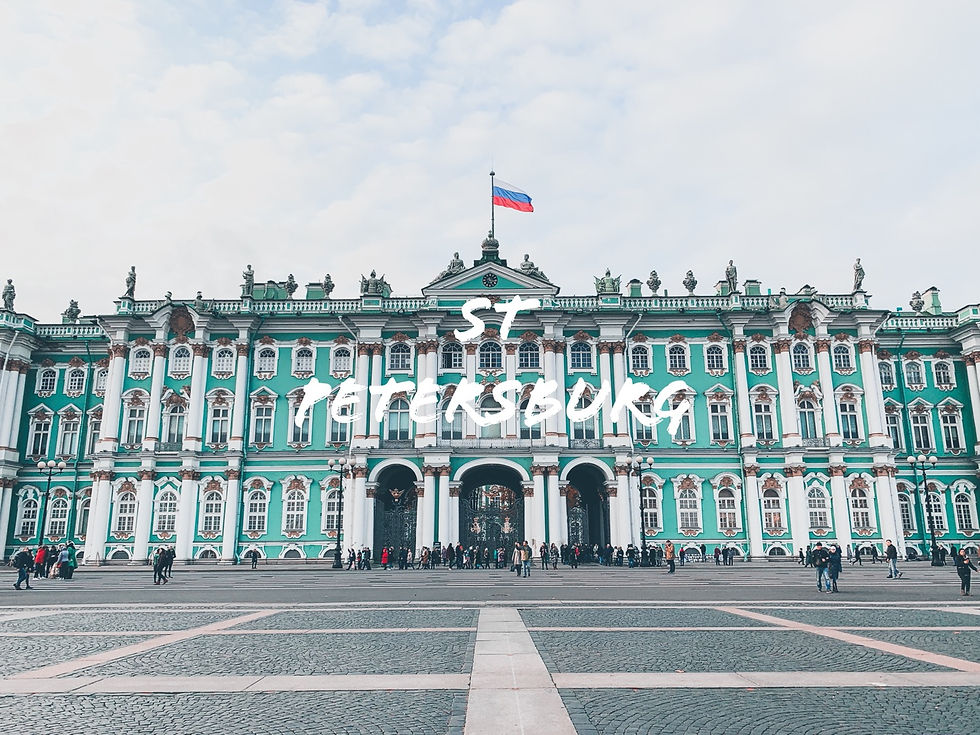
Church of the Sacred Blood, Me and my friends and St Pet Cathedral
(Credits to Jamie Lee for the beautiful pictures!)
Perfect for: Students looking to have a chill exchange experience (THERE IS NO BELL CURVE AND NO CLASS PARTICIPATION!). But be prepared to not able to travel for the first 2 months! (your passport will be taken for visa extension which will take at least 6 weeks to complete)
Ease of getting in: Not a very popular choice so it’s pretty easy to get in. I got it in the second round with 60+ points.
School culture: I think the students are quite friendly and they do take their work very seriously. I think they don’t mind teaming up with exchange students as long as we do the work. But, they do party quite a bit outside school as well (it is Russia after all). The locals outside of school, however, are not as friendly as it is not in their culture to smile at strangers. Plus, the language barrier makes it hard to communicate especially with the older generation.
Attendance levels: No attendance taken.
Exam policies: GSOM generally offers either written exams or online exams depending on the module taken. As GSOM’s Fall semester ends in end January which clashes with the start of NUS’ second semester, we were offered alternative exam dates whenever possible. Otherwise, they allowed us to take a proctored written exam in NUS.
Modules: What I specialize in: Marketing and Business Economics What I mapped: Strategic management, Econometrics (BSE), Innovation and Productivity (BSN/BSE), Topics in Operations & SCM (DOS), Topics in Finance (FIN) Tip: Would not recommend a marketing major to apply as there was no marketing module offered (not sure about Spring Semester though). Good for Finance and Operations majors!
Location: The bachelor campus is located far outside the city. It takes about 1.5hrs by bus and metro (or about 30 mins by car) to get to the city but there is a direct bus to the nearest metro station. Takes about 2 hrs to get to the airport by public transport (or about 30 mins by car).
Getting around: Very affordable with a student public transport card (BSK) which is similar to student concession in Singapore. It costs 250 rub (~ SGD 5) to issue the card and 1035 rub (~ SGD 20) monthly. The card includes 100 rides in metro and unlimited number of rides by buses, trams and trolleybuses per month. It is sometimes accepted in minibuses (marshrutkas). Otherwise, marshrutkas usually cost 40 rub (~ SGD 0.80) per ride. Ride hailing apps (Yandex or Bolt) are pretty affordable too. An average trip to the city costs about 700 – 800 rub (~ SGD 14-15) from the school area. **Tip: Avoid marshrutkas as there are no bells so you need to tell the driver directly when you want to alight. Avoid taking cabs off from the road as they may overcharge you. Use Yandex or Bolt.
Cost of living: Low/ cheap! Average price of a meal is about 300 – 400 rub (~ SGD 6-8). Groceries are also really cheap. Our average spending on groceries is about 2000 – 3000 rub (~ SGD 40 – 60) for 3 person.
Accommodation: GSOM automatically enrols all exchange students for their dormitories so you will need to opt out if you decide not to stay. The dormitories are very affordable but the conditions are not very good. (i.e. the toilets were quite dirty, there are no hooks in the cubicle so you need to change outside with other people and you cannot choose your roommate). Another thing to consider is that the Master campus is located in the city. Although we don’t study there, the student exchange office is located there and most activities organised by GSOM are also located at the Master campus. We found an accommodation near the school but it was far from the city so it was quite troublesome to travel! I would recommend you to find a place in between the school and the city. Otherwise, it would be better to stay in the city although it would probably be more expensive.
Additional tips: The language barrier is intense outside of school (almost nobody speaks English) so remember to download google translate!
You have to re-register your accommodation every time you leave the country or stay at a hotel in Russia! (migration regulations)
Be prepared to pay slightly more for flights to neighbouring countries and to Europe as the Pulkovo Airport is very small and has limited flights. Otherwise, you can consider taking overnight buses!
GSOM offers a 5 day Beginner Russian Course (at the Master Campus) that you can apply for!


Comments